Food and Drink
 Shopping
 Transportation
 Accommodation
 Useful Tips
 By city
 By Interests
 Pre-departure Guides
 Travel Updates

For first-time visitors, China’s scale can feel hard to grasp, encompassing imperial capitals, vast deserts once crossed by Silk Road caravans, and a Great Wall stretching over 21,000 kilometers. With the right planning, however, it becomes navigable.
If you are planning a first trip to China, here is how we recommend approaching it.
- Visas and entry requirements
- When to visit China
- How many days for a first trip to China
- Where first-time travelers usually go
- Getting around China
- Where to stay in China
- What a trip costs
- What traveling with WildChina is like
- WildChina journeys for first-time visitors
- How we plan your journey
- Preparing before you travel
Visas and entry requirements
Visa policy has shifted significantly in recent years, and many travelers are surprised by how accessible China now is. A growing number of nationalities can now enter visa-free for short stays. Others qualify for the 240-hour transit visa, allowing up to ten days in designated regions when transiting onward. For those who still require a tourist visa, the process is straightforward when started early.
While WildChina does not process visas directly, we partner with trusted visa agencies who can assist with applications and documentation when required. We advise confirming eligibility early in the planning process. Our guide to transit visas and visa-free travel outlines the options clearly.
When to visit China
We generally recommend spring (March to May) and autumn (September to November) for first-time visitors, when temperatures are moderate across much of the country.
In Beijing, spring brings apricot, peach, and magnolia blossoms, while autumn brings ginkgo-lined avenues and red maples across temple grounds and parks. In Xi’an and Chengdu, daytime temperatures during these seasons typically range from about 15–26°C, comfortable for walking and outdoor sites. Winter can also work well in Beijing and Shanghai, with fewer crowds and clear skies.
Major national holidays see significantly higher domestic travel. Chinese New Year (typically late January to mid-February), Labor Day in early May, summer school holidays, the Mid-Autumn Festival (mid-September to early October), and Golden Week in early October bring busy transport hubs and popular sites operating near capacity. When schedules allow, traveling outside these periods generally makes for a more comfortable experience.
For a deeper breakdown by region, explore our seasonal travel guides.

How many days for a first trip to China
For a first trip to China, we recommend allowing around twelve days. China is larger than most first-time visitors expect, and distances between regions are considerable. For example, Beijing to Xi’an takes around four and a half hours by high-speed train, while Xi’an to Shanghai takes around six hours. Each place also moves at its own pace. With fewer days, the experience can feel rushed; with more time, it becomes possible to explore more fully. Around twelve days strikes a comfortable balance between range and depth.
Where first-time travelers usually go
Many first trips to China with WildChina begin in Beijing. It is where China’s imperial past is most visible, in palace complexes, ceremonial temples, and the Great Wall stretching across the hills. Starting here provides context.
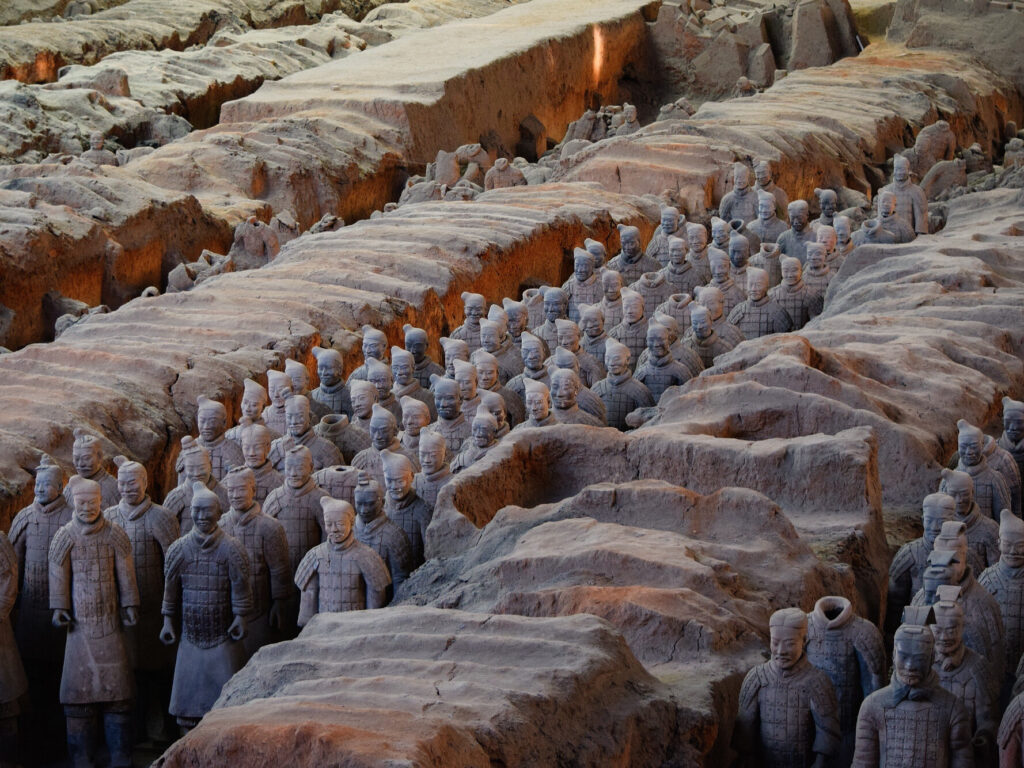
From there, we suggest a second destination that reflects your interests and a different chapter of the country’s story. For some, that means Xi’an, where China’s first unified empire took shape, reflected today in the Terracotta Warriors. For others, it may be Chengdu for pandas and a cuisine rooted in regional identity. Others continue to Yunnan for time in rural villages and mountain landscapes, or to Guilin for life along the Li River.
The journey could conclude in Shanghai or Hong Kong, where contemporary China comes into view through financial centers, layered architecture, and international influences.
There is no single correct route for a first trip to China. What matters most is that the journey reflects your interests, your pace, and the kind of experience you hope to have. We design your trip around what feels most meaningful to you.
Getting around China
China’s transport network is one of the most advanced in the world. When possible, we recommend high-speed rail over domestic flights, as stations are centrally located and the journey itself becomes part of the experience. Trains connect major cities efficiently and comfortably. Tickets are released 15 days before departure, and premium seats are limited. Because bookings open to the public at the same time, preferred classes can sell out quickly, particularly on busy routes. If the preferred class is unavailable, we secure the closest alternative.
Domestic flights are widely available and business class is often accessible at a reasonable supplement. First-class cabins operate only on certain aircraft, so availability depends on the route and travel date.
On the ground, we use professional chauffeurs and premium vehicles suited to each region, from spacious vans to electric sedans in cities such as Shanghai and Chengdu. Airport VIP services can also be arranged for those who value additional efficiency on arrival.
Where to stay in China
Accommodation plays a significant role in how China is experienced. We work with a range of carefully selected properties, including international five-star hotels, heritage boutique residences, and new luxury openings. In Beijing, that may mean a restored courtyard hotel near the Forbidden City. In more remote regions, it could involve lodges that reflect local architecture and landscape. Comfort and location are always considered alongside atmosphere and context.
What a trip costs
A privately guided journey with WildChina in mainland China typically starts from around 500 USD per person per day (NET), based on two travelers.
This includes:
- An English-speaking WildChina guide
- Private vehicle and chauffeur
- Five-star accommodation with breakfast
- All site admissions
In Hong Kong, journeys generally start from around 600 USD per person per day (NET), as overall travel costs are higher.
What traveling with WildChina is like
What makes a WildChina journey different is the people behind it, often the part travelers remember most from a first trip to China. Across the country, we work with experienced local guides, experts, and long-standing hosts who add perspective beyond the landmarks. The goal is not simply to move through places, but to experience China through meaningful encounters.
In Beijing, that might mean walking a quieter section of the Great Wall with a member of the Lindesay family, who have spent decades researching and conserving the Wall. In Chengdu, it could begin at a neighborhood market before preparing a meal with a local using regional ingredients.
WildChina journeys for first-time visitors
Every WildChina trip is designed individually, but we have a few journeys that can serve as a starting point. Our Essence of China journey is designed specifically with first-time visitors in mind, moving from imperial capitals to cultural heartlands and finally into modern city life.
The WildChina Travel Curriculum has journeys designed for first-time visitors through to seasoned China travelers, each building on the last. At the beginner level, travelers are introduced to China’s historical foundations and contemporary life in a considered and coherent way.
For those who enjoy traveling in a group and meeting like-minded travelers, our scheduled small-group journeys offer a shared introduction to China.

How we plan your journey
Every journey begins with questions. Who is traveling? Are there mobility considerations? Are your interests food, history, architecture, or a broader understanding of contemporary China?
We also consider pace. Some travelers prefer early starts and full days. Others value slower mornings, longer conversations, and time to absorb what they have seen. Your itinerary evolves from those answers, shaped around how you prefer to travel and what you hope to take away from the experience.
Preparing before you travel
Before a first trip to China, it helps to prepare for how daily life works. China today is highly digital. Most daily payments are made through platforms such as Alipay and WeChat Pay, so we suggest setting these up before departure to ensure transactions are seamless once in-country.
Practical questions often come up at this stage — what to pack, whether adaptors are needed, or how to access familiar apps while traveling. Our Pre-Departure Guide brings these details together in one place, and your WildChina travel designer remains available throughout the planning process to answer questions and ensure everything feels straightforward before you travel.
China is vast, but it does not need to feel overwhelming. With the right structure and guidance, a first trip to China becomes clear and deeply rewarding.
When you are ready to begin planning, we are here to design your journey with you.